
A flight from Augsburg to St. Moritz — across the snow-covered Alps and into one of Europe’s most extraordinary airports.
There are flights where the destination is the reason for going. And there are flights where getting there is the reason.
Flying a Cessna 172 from Augsburg to Samedan belongs firmly in the second category.
Leaving southern Germany behind, the landscape gradually begins to change. The horizon rises, the terrain becomes more dominant, and eventually the Alps stop being something in the distance. You are flying among them.
For a pilot used to navigating across comparatively open terrain, this changes the character of the flight completely.
Into the mountains
On a clear day, crossing the Alps visually is extraordinary.
Snow-covered peaks stretch across the horizon while valleys become the natural corridors through the landscape. Familiar names from the ground suddenly appear in an entirely different context. The route takes you across some of the best-known skiing regions of the Alps, with places such as Ischgl and Davos appearing below and between the mountains.
From a Cessna 172, everything feels remarkably immediate.
You are not looking down from an airliner at a distant mountain range. You are travelling through a landscape whose scale is constantly apparent through the windows.
And that makes VFR navigation here particularly fascinating.
A valley is no longer simply scenery. It has direction. A pass has height. Terrain that looks obvious on a chart acquires an entirely different presence when it is outside the windscreen.
The moving map remains useful, of course, but the flight becomes intensely visual: comparing the terrain outside with the route you prepared, identifying valleys and passes, maintaining awareness of altitude, weather and the possibilities ahead.
There is something wonderfully fundamental about it.
You look outside. You understand where you are. And you continue.

Towards the Engadin
Eventually the route leads towards the Engadin and Samedan.
The airport lies at 1,707 metres — 5,600 feet — above sea level, surrounded by high Alpine terrain. Engadin Airport describes itself as Europe’s highest-altitude airport. Engadin Airport St. Moritz – Samedan
This is also where the flight demands particular preparation.
Approaches and departures take place in a narrow Alpine environment and across mountain passes. The airport therefore requires pilots flying into Samedan to complete a dedicated familiarisation briefing and test before departure. Engadin Airport St. Moritz – Samedan
It is more than an administrative exercise.
The briefing makes very clear that this is an airport where the surrounding geography matters. Samedan provides an Aerodrome Flight Information Service rather than conventional ATC sequencing, and arriving pilots have to understand the local procedures as well as the particular demands of operating in this environment. Engadin Airport St. Moritz – Samedan
That knowledge changes the approach long before the runway appears.
Landing at 5,600 feet
There is a wonderful moment when the destination finally becomes part of the landscape you have spent the flight navigating through.
After mountains, passes and valleys, there is suddenly an airport.
The runway at Samedan sits on the floor of the Engadin valley, with mountains rising around it. Even after studying the charts, watching the approach material and completing the required briefing, seeing the geography from the cockpit is something else entirely.
The approach demands attention, but that is also what makes it so satisfying.
This is not a flight where the last ten minutes are merely the process of arriving. They are part of the experience.
And then the wheels touch the runway at 5,600 feet.
The mountains that have filled the windscreen for much of the journey are suddenly standing around you.
Engine off.
Silence.
And an aircraft that looks rather small against the Engadin.
The important part
There is, however, one final part of the procedure that no pilot briefing adequately prepares you for.
Engadiner Nusstorte.
After crossing the Alps in a Cessna, navigating through some of the most spectacular terrain in Europe and landing at Samedan, a piece of the local walnut-and-caramel speciality feels less like cake and more like a perfectly reasonable conclusion to the flight.
Perhaps that is what I like most about travelling in a small aircraft.
The distance between two places becomes something tangible. You watch one landscape turn into another. You navigate through it rather than simply passing above it. And when you finally arrive, the journey and the destination still belong together.
Augsburg feels a long way away.
Not because of the number of miles flown.
But because of everything that happened between take-off and landing.
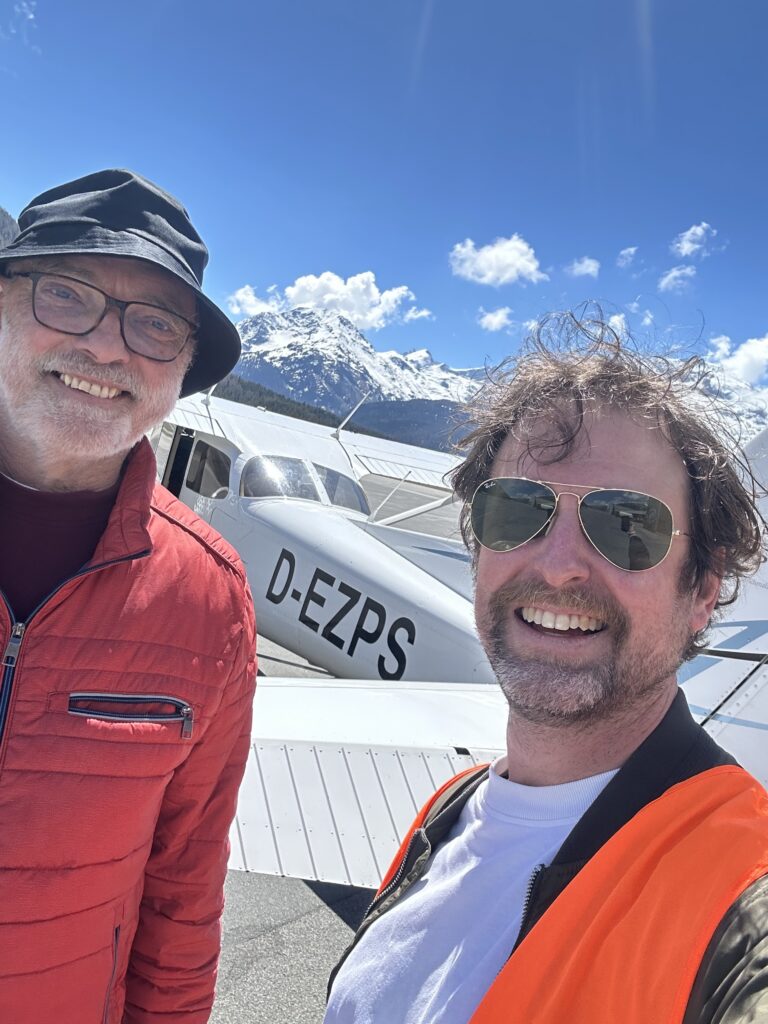
Aircraft
Cessna 172
Route
Augsburg → Alps → Engadin → Samedan
Destination
Engadin Airport / LSZS
Field elevation
5,600 ft / 1,707 m