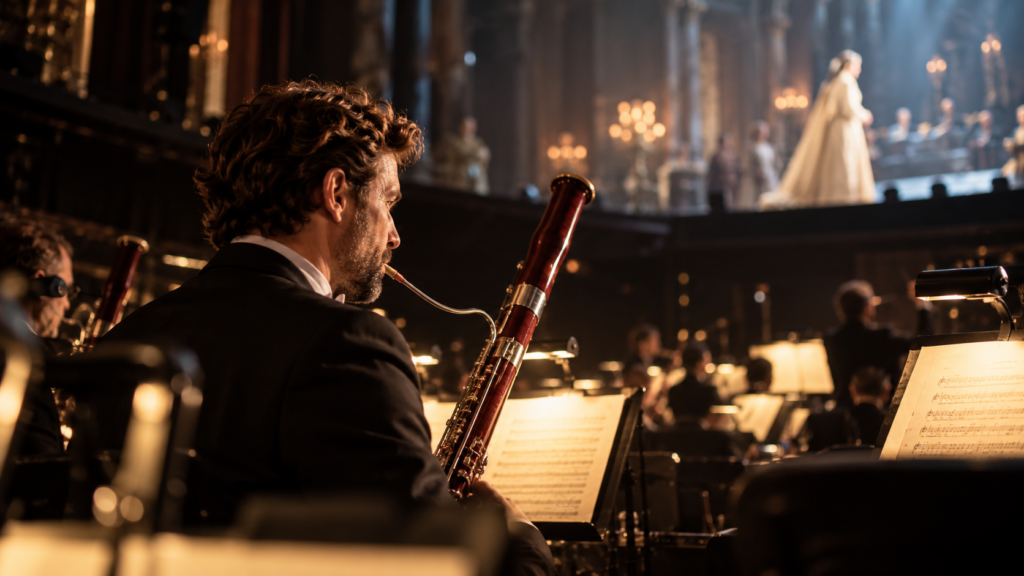
From forty metres of orchestra pit to a singer on stage: playing opera is a constant exercise in listening, reacting and deciding what it means to be together.
From the audience, an orchestra can appear to function as a single instrument. A conductor gives a beat, the musicians respond, and somehow a hundred people arrive at the same moment.
From inside an opera pit, it feels rather different.
Who I am listening to changes constantly.
There are moments when the bassoon plays almost alone. A few minutes later, I may be accompanying a singer on stage. Then the entire orchestra enters, and suddenly I am part of a much larger sound — with musicians at the opposite end of the pit who may be around forty metres away.
Playing together is therefore not simply a question of following the beat.
It is a continuous process of listening, anticipating and deciding.
Forty metres apart
An opera orchestra can occupy an enormous space.
The bassoons and the brass, for example, can sit at opposite ends of the pit. Across roughly forty metres, even the speed of sound begins to matter: sound needs a little over a tenth of a second to travel that distance.
That may not sound like much. Musically, it is enormous.
If I simply wait until I hear a note from the other side of the orchestra and then react to it, I am already too late. Instead, experience creates a kind of internal map. You learn how the orchestra feels across the room, how colleagues respond and how what you see relates to what you hear.
And then there is the conductor.
In the German orchestral tradition, playing together does not necessarily mean placing every note mechanically on the exact instant of the visible beat. There can be a small amount of space behind the gesture.
That space is useful.
It gives musicians the possibility to make decisions. At one moment I may need to connect precisely with another woodwind player. At another, the important relationship may be with the brass on the other side of the pit. And when accompanying a singer, the musical centre of gravity may suddenly be on stage.
Being together can mean something slightly different from one phrase to the next.
Listening to someone you cannot see
After many years in the same opera house, something else happens: you begin to know what is taking place on stage even when you cannot actually see it.
From my seat in the pit, I usually see only the first few metres of the stage. Much of the production happens somewhere above and beyond my field of vision.
And yet the stage is constantly present.
A singer breathes differently before a phrase. A dramatic moment changes the timing. Movement on stage affects how music and action meet. After playing the same operas repeatedly over many years, these relationships become familiar enough that the production develops a kind of invisible geography.
You know where you are.
Not because you can see everything, but because you have learned to recognise what is happening through sound, timing and experience.
The show must go on
The opera pit also has one considerable advantage over the concert stage:
Most of the audience cannot see us.
That creates a certain freedom.
A performance can last five or even six hours. Maintaining the physical formality of a symphonic concert for that amount of time would make little sense. In the pit, it is possible to remain more relaxed and concentrate on what actually matters: the music and what is happening around us.
And sometimes quite a lot happens around us.
A piece of scenery may malfunction. A prop may suddenly fall into the orchestra pit. Something on stage takes longer than expected. A singer reacts differently. An entrance does not happen exactly as it did yesterday.
Opera is live theatre.
Unexpected things are not exceptions to the system. They are part of it.
The response is usually remarkably unspectacular: the show must go on.
Everyone adjusts. The conductor reacts, the stage reacts, the orchestra reacts. We try to produce the best possible performance even when the circumstances are suddenly different from those we expected.
Ideally, the audience never knows how much has just changed.
More than rhythm and intonation
Perhaps this is also one of the things I understand differently today than I did as a student.
When you are young, it is easy to think of good orchestral playing primarily in terms of things that can be measured: rhythm, intonation, articulation, precision.
All of those things matter.
But they are not enough.
A performance can be rhythmically precise and perfectly in tune and still fail to draw anyone in.
What ultimately makes music convincing includes things that are much harder to quantify: feeling, authenticity, intention, commitment.
An audience may not consciously identify any of them. Most listeners will never think, that phrase felt authentic or the orchestra was particularly committed at that moment.
But they perceive it.
It is the difference between reproducing the notes correctly and making an audience believe what is happening.
And perhaps that is what playing together ultimately means.
Not a hundred musicians trying to execute exactly the same instructions at exactly the same instant.
It is a hundred musicians constantly listening, reacting and making small decisions — while somehow creating the impression of a single musical thought.